Thermostatistics
On the previous lectures you might have dealt with the empirical laws of thermodynamics, where different macroproperties were correlated with each other in a structure of few simple equations. This powerful formulation is somewhat uncomfortable - at least for me - and perhaps for many people. Could we describe thermodynamics in a more ab-initio way? That would be nice - however there is one serious issue with this approach. The number of particles we are often dealing with are crazy. It is usually something on the order of \(10^{23}\). How would you ever do this?
“Anyone who wants to analyze the properties of matter in a real problem might want to start by writing down the fundamental equations and then try to solve them mathematically. Although there are people who try to use such an approach, these people are the failures in this field…”
— Richard Feynman
One idea would be to lean in to the large particle numbers. Consider as an example a group of students. It might be very difficult for you to predict how group of 20 students would perform on an exam. But if you were to take 1e23 independent students (gosh) and look at their result scores - this would get easier. Statistics works in your favour.
When the numbers are large one can easily use statistics. And so they split the 'state' into two - a macrostate and a microstate. Macrostaste will be the observable such as Temperature, or Pressure, or average energy. Microstate will be all the possible configurations of particles. Many microstates correspond to each macrostate.
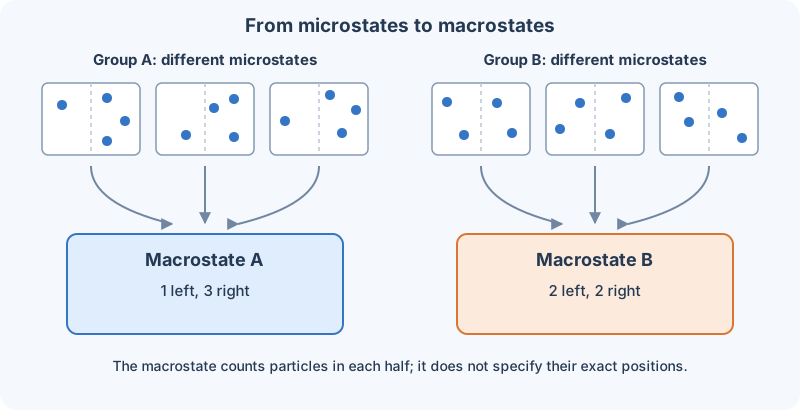
Each macrostate corresponds to many microstates. Here the macrostate records only the number of particles in each half of the box; it does not specify their positions or velocities.
For instance if we consider an ideal gas of particles the macrostate is the set of variables (p, V, N, T). Microstate is the record of the positions and velocities of all the particles \(\{q_i, p_i\}\).
Postulate of equal a priori probabilities
For an isolated system in equilibrium, every microstate consistent with the system's boundary conditions is assigned equal probability. For example, with fixed particle number \(N\), volume \(V\), and energy in a narrow interval \([E,E+\Delta E]\), if there are \(\Omega\) accessible discrete microstates, then
Microstates outside the specified constraints have probability zero.**.
For a classical system, phase space is continuous: the corresponding statement is that equal volumes of the accessible region of phase space have equal probability, rather than that individual phase-space points have a finite probability.
By counting microstates and taking averages, we then perhaps derive some of the properties.